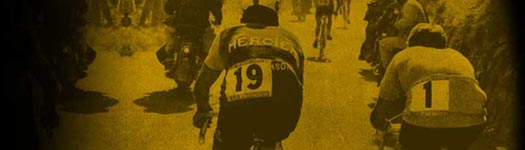
Federico Bahamontes vs Jesus Lorono: “Clash of Spanish Egos”
Federico Bahamontes (a Castilian and the darling of the Franco regime) and Jesus Lorono (a true Basque and a fierce separatist) had the entire “Spanish / Basque” rivalry going during the late 50’s and early 60’s.
Federico Bahamontes won the Tour de France GC 1959, TdF KoM six times, TdF 7 stage wins, Giro d'Italia KoM once, GdI 1 stage win, Vuelta a Espana KoM twice, VaE 3 stage wins.
Jesus Lorono won the Vuelta a Espana GC 1957, TdF KoM 1953.
Bahamontes and Lorono both had huge “egos” that clashed. Their rivalry was fueled by pressure from their sponsors to get results and the passionate Spanish press to deliver sensational stories. Their “ego conflict” prevented them from being solid teammates on Spain’s National Team.
Their hatred for each other so intense that “personal success” became more about beating each other than winning a race.
In Spain, the popularity of La Vuelta a Espana began to expand in 1956. The National Team had an incredibly talented group of riders, but the team experienced internal personality problems.
The conflicts included:
Vuelta a Espana 1956: Passionate Spanish stars put pressure on Spanish National Team led by director sportif Luis Puig.
Italian Angelo Conterno (+8”) was the race leader through fifteen stages. Bahamontes attacked and escaped the peloton on the brutal climb of the Urkiola. He became the “race leader on the road.” A solo Bahamontes suffered a series of punctures on the descent of Urkiola. Teammate Jesus Lorono led a hard chase with a tiring Conterno on his wheel. The “Lorono group” caught Bahamontes and helped Conterno maintain his fragile race lead.
Tensions from the rivalry were increasing.
Vuelta a Espana 1957: The conflict erupted in 1957. Bahamontes and Lorono headed the Spanish National Team again led by Puig.
The race exploded during the tenth stage. Early in the 192 km stage, Lorono slipped into a strong breakaway group. The race leader rode in a passively peloton and watched the breakaway built over a 21-minute lead. With no real chase or help from the Spanish team, the final time gain for the breakaway in Tortosa was 21'59”. Jesus Lorono erased a 15'54” deficit to Bahamontes and gained his first race lead.
Emotions boiled over after the stage at the hotel. Intense arguments between Lorono supporters and Bahamontes supporters needed to be addressed. Puig met with the team at their hotel and cut off all the external communication with the press. “It is a success and we are a team.”
From that meeting emerged the so-called Pact of Huesca. The Team’s race strategy emerged:
- Bahamontes attacked on the last climb to maintain the lead in the KoM and protect his second place overall.
- Lorono would ride as the race leader for the final seven stages.
But the hostilities were not over. Lorono, fourth overall in 1955 and second in 1956, cemented his race lead with a victory on the Stage 13 Individual Time Trial. After heated words with teammate Bahamontes prior to the start, race leader Lorono rode to the stage win and gained another 1'06” on his angry teammate.
Jesus Lorono, one of the great champions in the history of Spanish cycling, achieved the Vuelta victory beating Federico Bahamontes in 1957.
This fateful Vuelta 1957 took the rivalry to a new level.
Vuelta a Espana 1958: The collapse of the Spanish team’s unity and the fierce rivalry between its two stars, Bahamontes and Lorono, appear as early as the third stage. Jean Stablinski (Fra) and Francois Mahe (Fra) escaped the peloton and quickly gained valuable time. Realizing the strength of the group, Bahamontes bridged up to the breakaway. Feeling slighted, team leader Lorono led the chase of his teammate Bahamontes. Once the group was back together, Lorono counter-attacked with Belgian Hilaire Couvreur, who was third in the General Classification. The breakaway succeeded, with Pierino Baffi (Ita) winning the stage, 13'40” ahead of the peloton. If not for Lorono's effort to get Couvreur into the breakaway Bahamontes would have taken the Amarillo Jersey. This was another in a lengthy line of ‘passion driven' errors committed by the Spanish team.
On the evening before the 35 km Individual Time Trial from Bilbao to Castro Urdiales, the Spanish team director Luis Puig declared that because of the buffoonery of his two stars, he will no longer direct the Team Espana. Reacting to the director’s statement Jesus Lorono declared himself the team leader. The cohesion of Team Espana hit a new low.
Tour de France 1959: The Tour was raced with National Teams, and in 1959 Team Espana still had to face another scandal. Director sportif Dalmacio Langarica chose Bahamontes and Antonio Suárez as leaders for Spain. The decision prompted the resignation of an angry Lorono, who sanctioned with a two-month suspension for assaulting the coach.
Federico 'the Eagle of Toledo' Bahamontes climbed steadily to the victory! He became the first Spanish rider to win the prestigious Tour de France.
It was one of cycling's bitterest rivalries. This story blends economic (battle for sponsorships), social (battle for fan support), political (Basque separatist vs Spanish Nationalist), and personal conflicts of the late 50’s.
There were many battles in the Vuelta, complete with drama on the roads and in the hotels, and their refusals to ride in the same teams. Essentially it was an extension of the Spanish civil war into the 50’s.
A dinner party invitation to both might NOT be a good idea.
|